
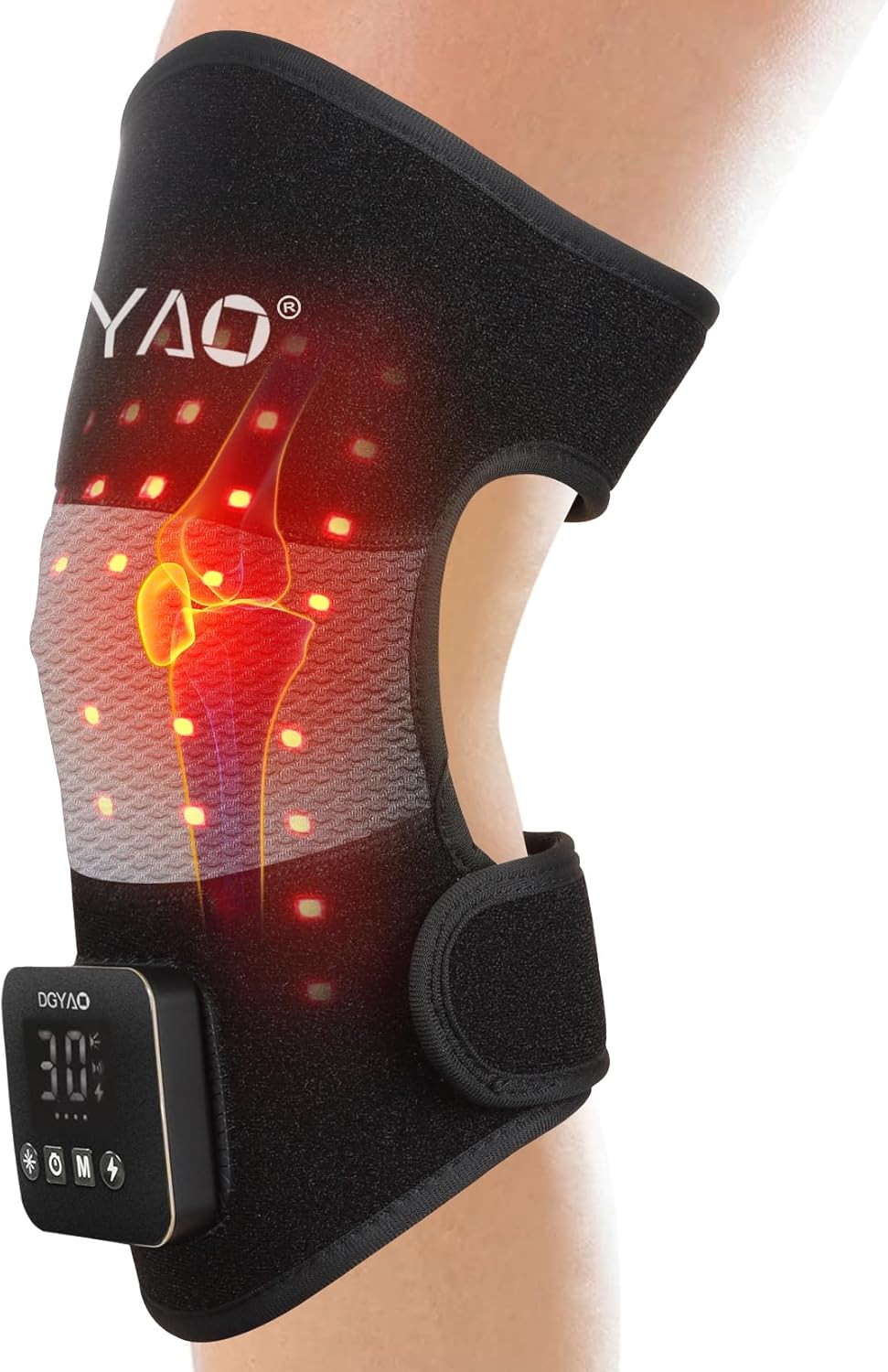
DGYAO
Infrared Knee Wrap
$50
Pros & Cons
Pros
- Purpose-built for knee anatomy — contoured wrap design keeps LEDs in contact with the joint during treatment
- 660nm + 850nm dual wavelength targets both surface inflammation and deeper joint tissue
- Flexible enough to wear during light activity or physical therapy
- Sub-$60 price makes it the most accessible way to test red light therapy for knee pain
Cons
- Low irradiance compared to panel devices — works best with consistent daily sessions rather than occasional use
- Elasticized fit doesn't accommodate very large or small knee circumferences equally well
- No published irradiance data from manufacturer makes clinical comparisons difficult
At a Glance
Overview
The DGYAO Red Light Therapy Knee Wrap is the cheapest sensible way to try red light therapy for knee pain — a $50 contoured wrap that puts 660nm and 850nm LEDs directly on the joint where a rigid panel can't reach. If you're dealing with knee pain and don't want to commit to a $300+ panel to find out whether red light helps you, this is the lowest-risk entry point in the category.
It uses 60 LEDs across a flexible 12-by-6-inch wrap at about 20 mW/cm², with the two wavelengths that matter for inflammation and deeper joint tissue. The contoured design is the point: it holds the light in contact with the knee during treatment, and it's flexible enough to wear during light activity or physical therapy.
The honest expectations: at $50 and ~20 mW/cm² this is a low-irradiance device that rewards consistency, not a clinical-grade panel. It works best with daily sessions over four to eight weeks rather than occasional use, the elasticized fit doesn't accommodate every knee size equally, and the manufacturer doesn't publish detailed irradiance data. This review covers who it's right for and what to realistically expect.
DGYAO Red Light Therapy Knee Wrap
Prices may change · Free shipping with Prime
Design & Fit
The DGYAO wrap is purpose-built for knee anatomy — a contoured, elasticized band that curves around the joint and holds the 60 LEDs in contact with the skin. That contact is what makes a wrap outperform a panel for a joint: the light stays on the target instead of dispersing across a flat plane held at a distance.
At 0.4 pounds it's light and flexible enough to wear while sitting, stretching, or doing gentle physical-therapy movements. The main fit caveat is the elastic sizing: it fits average knees well but doesn't accommodate very large or very small circumferences equally, so if your knees are outside the typical range the contact (and therefore the dose) may be uneven.
Wavelengths & Output
The wrap runs 660nm red and 850nm near-infrared — the correct pairing for joint work, since 850nm penetrates deeper toward the tissue and circulation under the skin while 660nm addresses surface inflammation. For a targeted knee device, that dual-wavelength coverage is exactly what you want.
Where it's modest is intensity: at roughly 20 mW/cm² the irradiance is well below panel-style devices, and DGYAO doesn't publish detailed irradiance data, which makes precise clinical comparison difficult. The practical implication is dose-by-consistency — you make up for lower intensity with regular, longer sessions rather than a few high-powered ones. It's a device for daily habit, not occasional blasts.
Realistic Use & Results
The DGYAO has no built-in timer, so you'll time sessions yourself, and the low irradiance means results depend on sticking with it. The realistic protocol is daily sessions over four to eight weeks before judging whether it helps your knee — red light therapy for joints is cumulative, and a $50 low-power device especially rewards consistency.
Set expectations accordingly: this isn't going to deliver a dramatic overnight change, and it's not a substitute for medical treatment of a serious knee problem. But as a low-cost, low-risk thing to try daily before more expensive interventions, it's genuinely worth a run for mild-to-moderate knee discomfort.
Value & Who It's For
At $50 the DGYAO's value case is simple: it's the most accessible way to test red light therapy for knee pain specifically. You're not getting panel-grade irradiance, a timer, published specs, or a long warranty (it's one year), but you are getting the right wavelengths in a knee-contoured wrap for the price of a couple of physical-therapy co-pays.
Buy it if knee pain is your specific concern and you want to try red light cheaply before committing more. If you want higher intensity or coverage for multiple joints, a wearable belt (like the BestQool Belt) wraps larger areas, and a full panel with 850nm covers the whole body — but for a focused, budget knee experiment, the DGYAO is the direct path.
Who Should Buy the DGYAO Knee Wrap
Buy the DGYAO Knee Wrap if you have knee pain, want the correct 660nm + 850nm wavelengths in a joint-contoured design, and want to try red light therapy for under $60 before spending more. Used daily and consistently, it's a reasonable low-risk experiment for mild-to-moderate knee discomfort.
Look elsewhere if you need higher irradiance or want to treat several areas — a wearable belt covers larger zones, and a full-body panel delivers far more output for whole-body recovery. And if your knee problem is significant, treat this as a complement to proper medical care, not a replacement. It's the budget knee-specific option, priced and specced honestly for that role.
My Verdict
For anyone dealing with knee pain who wants to try red light therapy without committing to a $300+ panel, the DGYAO Knee Wrap is the most direct path. The contoured design keeps the LEDs where they need to be — on the joint — and the dual wavelengths are the ones that matter for inflammation and tissue repair. Don't expect miracles from a $50 device, but consistent daily use over 4–8 weeks is genuinely worth trying before expensive interventions.
DGYAO Red Light Therapy Knee Wrap
$50
Prices may change · Free shipping with Prime
| Full Specifications | |
|---|---|
| Wavelengths | 660nm + 850nm |
| Irradiance | 20mW/cm² |
| LED Count | 60 |
| Coverage Area | knee / targeted |
| Power Draw | 8W |
| Dimensions | 12" x 6" x 0.5" |
| Weight | 0.4lbs |
| Wavelength Count | 2 |
| Built-in Timer | No |
| Pulsed Mode | No |
| Stand Included | No |
| EMF Level | low |
| Warranty | 1years |
| FDA Cleared | No |
Frequently Asked Questions
Does the DGYAO Knee Wrap actually work for knee pain?
Why choose a knee wrap over a red light panel?
What wavelengths does the DGYAO wrap use?
Does the DGYAO Knee Wrap have a timer?
Is the DGYAO wrap a good value at $50?
Related Buying Guides
Compare With Similar Red Light Therapy Devices
Head-to-Head Comparisons
DGYAO Red Light Therapy Knee Wrap
$50
Prices may change · Free shipping with Prime